
A name rooted here
Falstaff Farms takes its name from the history of this part of Herefordshire.
The estate includes Oldcastle Farm, the former home of Sir John Oldcastle, the Herefordshire knight whose story later became entwined with one of Shakespeare’s most famous characters.
When Shakespeare first created the figure we now know as Sir John Falstaff, the character was originally called Sir John Oldcastle. The name was subsequently changed, but the connection endured.
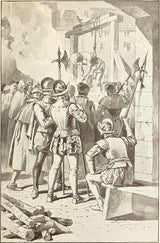
Oldcastle himself was a far more complicated man than Shakespeare’s Falstaff: soldier, landowner, religious dissenter and ultimately a rebel.. On December 14, 1417, Sir John Oldcastle was simultaneously hanged and burned alive at St. Giles' Fields in London. This highly unusual and brutal double-execution was a direct result of being condemned by both the Church (for heresy) and the Crown/State (for treason).
We do not claim his beliefs as our own. But something in his story still resonates — independence of thought, personal conviction and a reluctance to accept that established institutions must always know best.
Falstaff therefore felt like a name that belonged here.
The idea
Falstaff Farms began with a question:
How much of what a household needs could we once again produce from the land around us?
The ambition is simple, even if achieving it is not: to reach the point where, in principle, we could live from the estate without needing the supermarket.
We grow wheat for flour and bread. We keep Sussex hens for eggs. We raise livestock, keep bees, grow fruit and vegetables, preserve seasonal surpluses and continually look at what we buy today that we might instead produce ourselves tomorrow.
It is not conventional commercial farming.
It is closer to old-fashioned estate self-sufficiency.
Today it might be called homesteading, regenerative agriculture or sustainable living. Those ideas all overlap with what we are doing, but the underlying model is much older.
The walled garden
At the heart of the estate is our two-acre walled garden, said to be one of the largest fully cultivated walled gardens in the country.
For centuries, gardens like this existed for a practical reason: to feed the house.
We are trying to make ours do that again.
Fruit, vegetables, herbs and flowers are grown through the seasons, with glasshouses allowing us to extend what can be produced throughout the year.
The point is not simply to have an impressive garden.
It is to make it productive.
What comes out of it should eventually find its way into the kitchen, the pantry, preservation jars, or into the hands of our customers.
Farming for independence
We have become accustomed to other people doing almost everything essential for us.
Food is grown elsewhere, processed elsewhere, packaged elsewhere and moved through increasingly complicated systems before it arrives on the table.
We do not think that level of dependence is inevitable.
Knowing how to grow food, keep animals, mill grain, preserve a harvest or make use of a whole carcass gives you options.
And options create freedom.
For us, self-sufficiency is not about withdrawing from modern life. Nor is it about rejecting technology or commerce.
It is about retaining capability.
The more you can do for yourself, the less completely dependent you are upon somebody else doing it for you.
An older way of producing food
We favour traditional breeds and methods where they still make sense.
Our Sussex hens live and forage outdoors.
Our Hereford cattle grow slowly on pasture.
Our bees work the estate and surrounding countryside.
We grow our own wheat.
The walled garden follows the seasons rather than expecting everything to be available all year.
We compost, rotate, preserve and try to use what the land produces rather than wasting it.
The objective is not maximum yield.
It is a resilient system capable of producing genuinely good food.
Less, but better
Industrial agriculture is extraordinarily good at scale.
It can produce enormous quantities of uniform food, cheaply and consistently.
But once food is designed primarily around scale, other considerations inevitably become important: speed of growth, yield, transport, shelf life and uniformity.
At Falstaff we have the luxury of choosing differently.
We can allow an animal more time.
We can grow a variety because it tastes better rather than because it travels better.
We can accept that some things have seasons.
We can keep older breeds even when they are less productive.
We can hang beef properly, use the whole animal and preserve what the garden produces when it is abundant.
We would rather produce less and produce it properly.
From our estate to your table
Falstaff Farms began as a personal pursuit of self-sufficiency.
Selling food came afterwards.
As production has grown, there are things the estate produces beyond what our own household can use: eggs, honey, beef, seasonal produce and, increasingly, other food grown or made here.
So we make some of it available.
We are not trying to recreate a supermarket on a farm.
Some things will be scarce. Some will appear only in season. Certain cuts or harvests will sell out and not return until the land produces them again.
That is deliberate.
It reflects where the food actually comes from.
Falstaff Farms
What people now call homesteading, regenerative farming and self-sustainable living would once have been ordinary household knowledge.
Falstaff Farms is our attempt to recover some of it.
Not because the past was perfect.
But because independence, useful skills, good husbandry and food grown close to home still have value.
Grow it. Raise it. Make it. Understand it. Depend less.
Falstaff Farms, Herefordshire.